
Learning to Read - Pt. 1
A little series on how I went from not being able to read at 18, to becoming a writer. Part 1 - my first book. Autumn 2008.

2026 is the National Year of Reading in the UK: a banner year with a slogan and a mission and a neat little stamp: if you’re into it, read into it. Normally, I roll my eyes at these things. Gimmicks. Talking points. A ribbon-cutting for a problem that won’t be solved by an event.
But this feels different.
Learning to read cut my life open more cleanly than any set of scissors ever could.
Most people can’t remember a time before they could read. I can. For a long time, I was ashamed at the fact I couldn’t read by the time I was 18 years old. When I first stepped toward a creative life, I crashed into a wall of pretension, doors guarded by people with pockets full of references, little jokes that were little padlocks, spoke in names and titles and quotes like passwords. Cultural capital accrued like interest, like inheritance, like it was the most normal thing in the world to have been given a library at birth.
I had music. I had a very limited view of music. Nothing beyond the mainstream.
I had the feeling of wanting but not being able to reach.
When I say I couldn’t read, I mean I had the reading age of a 10-year-old.
When I say I couldn’t read, I mean I could recognise some words, but I didn’t know what they meant.
When I say I couldn’t read, I mean when the words I did recognise were strung together to make a sentence, I didn’t know what it meant.
When I say I couldn’t read, I essentially mean that, because my new vocabulary allows me to express it correctly, I was illiterate.
Thick.
A very simple reader who could only focus on the gaps between the words on the page, because I couldn’t understand what was being said from the words on the page.
Without being able to read, I couldn’t write either.
Obviously, things have changed since then. That sentence still surprises me when I write it, like I’m describing someone else. A few weeks ago, I handed in my final coursework for my Master’s Degree at the University of Oxford. That sentence still feels like it belongs to someone else, a different boy entirely, a boy in a different universe, a multiverse away from the snotty-nose eighteen-year-old version of me who didn’t believe there was a place in the world that didn’t end in a prison cell. To get to university, let alone an elite one, you have to be able to read and write.
Recently, I completed a reading speed test as I’m setting out to read 50 pages a day this year. My reading speed is 137 words per minute. This is SLOW. It turns out my current reading speed is the same as a ten-year-old’s. The same age as the reading age when I was eighteen and couldn’t read. The same age as when my dad died.
When people learn about my reading journey, I get two responses.
First is always denial. No way. I couldn’t imagine you like that. A story too ugly, too inconvenient, too embarrassing to attach to the person standing in front of them.
Then, once they see I’m being serious. How?
So, for the National Year of Reading, I thought it might be good for me to do a little series on my journey of learning to read.
Part 1 - My First Book. Autumn 2008.
Every children’s home I had been in had a ‘library’.
Sometimes that word meant a room with real shelves and the stale hush of dust which had given up on moving. Sometimes it meant a bookcase bolted to the wall as a statutory duty.
In a children’s home, ‘library’ was never a verb.
No one went in there.
No one took anything.
No one returned anything because nothing ever left.
By Autumn 2008, I was fifteen, and living in a small children’s home. The kind that tried to look like a home if you squinted your eyes really hard and ignored all the floating blue-and-white fire door stickers and locks on the doors. Our ‘library’ was a single bookcase tucked behind the living room wall, on the other side of the TV. A hiding place. A secret that wasn’t meant to be used.
I don’t know who chose the books. I don’t know how long they had been there. I only knew no one picked one up. No new ones arrived. No books were ever opened. They were props for children to vent their anger.
A care worker in my children’s home brought in a DVD. I was hoping she would remember, as she promised when she was last on shift, to bring it in. I held the white sleeve in my hands, sliding the case up and down inside it, a small restless ritual. The same way you fiddle with a lighter when you’re trying not to light anything. But she said to wait till after tea so we could watch it together.
And I waited.
I didn’t question my own compliance. A few months before, the mere suggestion I should have to wait would have sparked some kind of kick-off. Rage was my native language, and I spoke it well.
But those months had changed me in a way I didn’t have language for yet. I’d been spending most of my days sitting on the edge of the bed, teaching my fingers to dance on a fretboard with the synchronisation of a ballet. Trying not to trip over each other. Trying to make two hands agree on one intention.
Sometimes things click.
Sometimes the body learns something the mind can’t explain yet.
When my left hand wrapped around lacquered wood, when my right hand pressed down on the high-tension strings, something in me shifted. It sent me somewhere I hadn’t been in a long time. Since I was ten, when my father died, my world had been black-and-white. But whenever my fingernails scraped the strings, a bit of colour would seep in at the edges.
I felt less angry. It was addictive. But not destructive. I didn’t know that kind of addiction existed. Up until then, my addictive behaviour ruined lives, mostly mine. It sent me to hospital. It sent me to silly counselling sessions on drug safety. It sent me to court. Most of all, it made everyone hate me. I looked like a problem dressed in a boy’s skin.
This was different. [Care] Staff would smile at me rather than put up with me. The children’s home felt different, too. Home-like. Not safe, exactly. Not innocent. But less like a holding pen for mini volcanoes.
Usually, I would wolf my tea down as fast as I could. Not because I didn’t want anyone to steal my food, but because I didn’t want to be around anyone long enough for my skin to start buzzing with threat. I ate fast, so I could leave fast, so I didn’t have to look at faces, so no one could say my name in a tone I couldn’t handle. Instead, I took my time. Wednesday nights were Chicken Fajitas. A tradition, and also a subtle prank. The care worker, who worked most Wednesdays, was fed up with them, so I made sure they were on the menu every week. The food was dished out onto the table, ready for us to scoop, splatter, and splosh at our own pleasure. The kitchen smelled of paprika and hot oil. Tortillas steamed in the plastic bag from the microwave. The salsa made the air sharp. Among the spices and the mess, we talked about what songs I had been learning on the guitar. I had become obsessed with Johnny Cash, mainly because his songs only had three chords, so they were easier to play, but the rhythm was difficult.
After we finished, I raced across the corridor to the living room, whacked the DVD into the player, set it up, and then the deep tones of the blues slide guitar blew out of the TV as the Walk The Line DVD menu appeared. I was about to learn everything about the man who wrote the songs I had been learning for the past few months.
A lot of the film spoke to me, as I hoped it would. There were scenes where Johnny Cash is playing a guitar like mine. But one scene had me. Johnny Cash walks June Carter to her hotel room. She empties her bag to give him a copy of the Billboard charts with his song on it. But to get to it, she empties her bag. Books. A small spill of hardcovers. Johnny says, “You got a library in there?” It never occurred to me that this could be a compliment. Like a library is something a person carries around because they couldn’t bear to be away from books.
June hands him a book. A pale cover with a face imprinted: The Prophet by Kahlil Gibran. Just the title alone felt like a door. The care worker sat next to me, tapped my arm, and said all the best songwriters have a copy of that book. A word which promised knowledge. A hidden map. Prophet. Someone who knows. Someone who sees what other people can’t.
The next time the book appears, Johnny Cash is trying to write a song. Something in my chest tightened in a way the film had nothing to do with. Right there and then, I decided I wanted to write songs. I needed to read that book.
Not someday.
Not when I was older.
Not when I had a life that made sense.
Now.
I needed The Prophet. I needed a book. I needed the thing in his hands.
But I couldn’t read. I’d never read a book before. Not properly. Not the way people mean when they say, “I read this”. I’d never moved the pages on purpose, letting sentences build a world inside my skull.
I didn’t know how to.
Never thought I needed to. I thought reading was for wimps. That was the rule I lived by. Every boy in a children’s home seemed to live by. Books were soft, books were for school, books were for people who got to be children. Books belonged to kids who had homes. I was a young person in a unit. A case. A file. A risk assessment in trackies and trainers. And yet, there I was, watching a woman pull books from her bag, watching a man read his way into a song, and I was left with a sharp, unfamiliar sensation inside me.
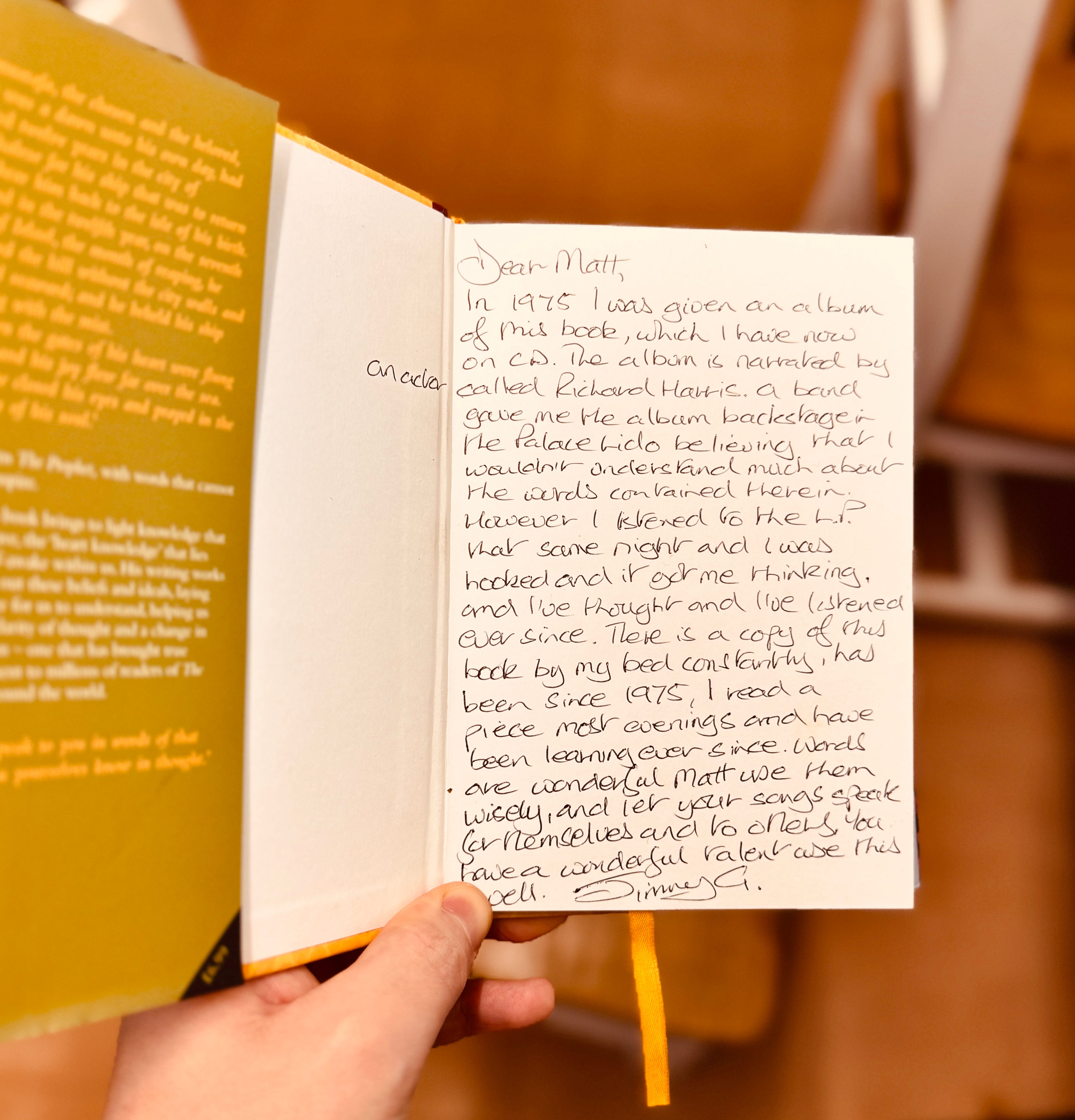
I went to bed thinking about the film. Thinking about the book. The next day, a care worker from another children’s home who played guitar, called Jimmy, came to visit and jam. He would visit every week. I told him about the book, and he said he had a copy I could have. I rubbed my hands in excitement.
He arrived the following week with a red and yellow book in his hand. It had a different-coloured cover from the film copy, but the face imprint told me it was the same door. This wasn’t his copy. It was brand new. I opened it, and on the first page, Jimmy had written the story of how he came about the book. I couldn’t read it. I couldn’t make the words hold still enough to make meaning. But he was there, so he told me anyway. His voice did the work my eyes couldn’t do yet. I held the book as if it were warm.
Now I had it. I didn’t know what to do with it. I couldn’t understand it. I knew the secret of being a great songwriter was in there somewhere. I was still obsessed with Johnny Cash, so I bought a copy of his autobiography, Cash, the one the film was based on. I thought I would have an easier time reading his book first, rather than the book with the secret. I also hoped somewhere in his book, he would just point to the paragraph and go, “ This bit. This is what turns you into someone else.” I wanted a shortcut.
The book was black with pictures in the middle. I stared at them for hours. The pictures felt like reading without the risk of failing. Then one night, I decided I should give it a try. It took me all night to read the first page, and none of it stayed in. I read and reread lines, not understanding what was being said. Forgetting each line as I moved on to the next. I tried to let the words conjure images. All I got was blackness, which made me doze off. My brain ached, my eyes burned, my head was heavy with a familiar shame.
Still, I kept the page open. Something kept telling me I needed to do this. It was like the feeling I had when I first strummed a guitar. I told myself if I could teach myself guitar, I could teach myself to read. I was terrible at guitar when I first picked it up, but with enough practice, I became fluent. I just needed to do it with the book.
Three chords.
Two hands.
One Page.
A door.
The word ‘library’ began to twitch, like I was ready for it to become a verb.
Part 2 to follow soon.
Did you know that liking this post or leaving a comment helps me connect with more readers? I’m guessing if you’ve read this far, you probably enjoyed the writing, so please click the heart below. Your support is valued - thank you 🙏.
If you haven’t succumbed to all the other pleas of subscribing. Be a hero and pop your email address in the box, and receive newsletters as they happen in your inbox.
I used to be a teacher with a specialism in reading and language. Your experience is exceptional. Very very few people who are still not fluent readers in their teens go on to develop the ability to write in the way you do. As a teacher my mantra was always “ read to your children.” read their favourite book a gazillion times, read books they can’t read themselves yet but teach them that books are more fun than anything else. This is how we build, language, vocabulary and give them the tools to make sense of the world. Without that scaffold, to achieve what you have is extraordinary. Be very proud of what you’ve done.
You write so well, Matt. I'm loving hearing your journey.
If I get some work soon, I'll upgrade - I promise